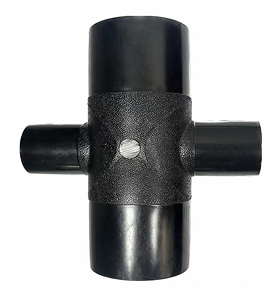
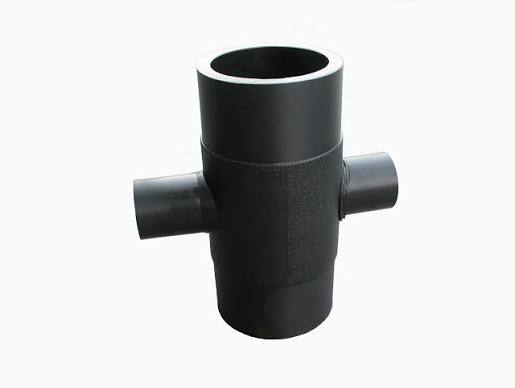
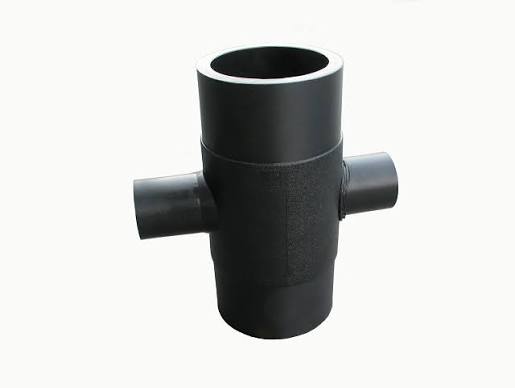
The HDPE Butt Fusion Reducer Cross for Fuel Gas is a PE100 RC reducer cross with butt fusion connections, designed for multi-branch diameter transitions in fuel gas distribution networks. It provides permanent seal integrity for complex flow distribution.
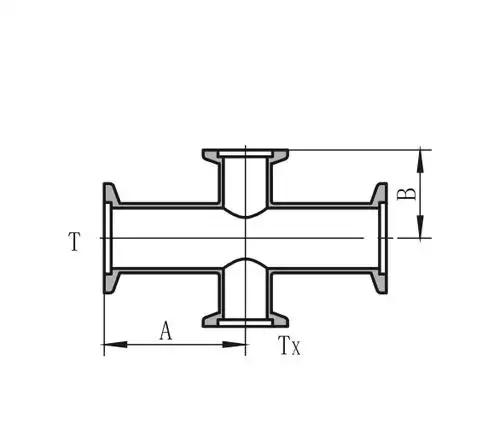
| Specification |
Value |
| Material | HDPE PE100 |
|---|
| Standard | ISO 4427 |
| Type | Reducer Cross |
| Pressure Rating | PN10 / PN16 |
| Size Range | DN20 - DN630 |
Key Features of HDPE Butt Fusion Reducer Cross for Fuel Gas
- PE100 RC material gives superior slow crack growth resistance.
- The automated butt fusion process ensures permanent seal integrity.
- The reducer design accommodates complex flow distribution requirements.
- Chemical resistance meets stringent fuel gas transmission standards.
- The fitting offers a 50+ year design life with maintenance-free operation.
Manufacturing Process of HDPE Butt Fusion Reducer Cross for Fuel Gas
Each is produced by computer-controlled injection molding.
Critical Process Parameters of HDPE Butt Fusion Reducer Cross for Fuel Gas
- Melt temperature control: ±2°C (190–240°C)
- Holding pressure: 70–100 MPa
- Precision cooling curve management
- Dimensional tolerance compliant with ISO 11922
- Surface quality: no flow marks or sinks
Raw Material Characteristics of HDPE Butt Fusion Reducer Cross for Fuel Gas
- Density: 0.950–0.955 g/cm³ (ISO 1183)
- Melt Flow Rate: 0.2–0.4 g/10min
- Tensile strength at yield: ≥25 MPa
- Slow crack growth resistance: ≥2000h
- Oxidation induction time: ≥30 min
Typical Applications of HDPE Butt Fusion Reducer Cross for Fuel Gas
- is used at branching nodes in urban gas distribution networks.
- serves pipe diameter transitions in industrial gas systems.
- is installed at pressure regulation stations in natural gas transmission.
- The fitting provides size transition points in CNG station piping.
Application Scenarios of HDPE Butt Fusion Reducer Cross for Fuel Gas
- Size transition and branching nodes on main gas pipelines — is the standard fitting for these connections.